Another one

Cecelia Kingman, representing the Ministerial Fellowship Committee (MFC) of the Unitarian Universalist Association (UUA), has sent another email notice to congregational leaders:

I know nothing about this situation. I did find that UU World magazine carried a notice of Cory Lovell’s ordination in their Spring/Summer 2024 issue; he was ordained by the Marin, Calif., congregation, and appears to have been working there since then. And as usual, I post this here because the UUA page listing people removed from fellowship is no longer publicly accessible.

Once again, reading one of these notices has gotten me thinking about the MFC process:

Continue reading “Another one”

A blow to “just war” theory

Pope Leo has issued an encyclical in which he state that “just war” theory is no longer valid:

In a news story about this encyclical on Religion News Service — posted less than an hour ago — reporters Aleja Hertzler-McCain and Jack Jenkins trace the pope’s statement on “just war” theory to a Vatican study group which issues a report this month in which they said:

I became a pacifist in part because Dan Greeley, the minister of my Unitarian Universalist congregation when I was in my teens, argued that war was no longer morally defensible after the invention of atomic weapons. War technology has only gotten more destructive since then, and I’m glad the Vatican has finally caught up with what Greeley perceived in the 1970s.

I only wish that today’s Unitarian Universalists would remember that war is a more urgent moral issue that the narrow United States culture wars issues that seem to get the most attention from our religious community. But the internationalism of Greeley’s generation of Unitarian Universalists has been mostly forgotten, and the culture wars are now considered of paramount importance.

Your politics are being manipulated

You’ve probably already seen (or heard about) the New York magazine article titled “The Feed Is Fake.” Here’s reporter Lane Brown’s lede:

The article is behind a paywall. Of course, you can find plenty of commentary giving summaries of the article on various social media outlets. Also of course, 90% of those commentaries are going to be fake. In other words, the problem with social media is not AI slop. The problem is hidden marketing campaigns that manipulate the algorithms of social media platforms to deliver the content they want you to see. Nor do the social media platforms mind, because all these marketing campaigns cause you to spend more time on their platforms.

If you use any of the major social media platforms — TikSlop, Youcrude, Facecrook, whatever — you’re being suckered into believing “people” are talking about things…that no one is actually talking about.

And it’s not just merch and music that are being marketed to you. Your politics are also being manipulated. Take, for example, the Superbowl Bad Bunny kerfluffle:

Remember this the next time you get all worked up about some issue from politics or the culture wars. There’s a 90% chance that whatever conflict you’re getting worked up about is a marketing campaign being forced on you. And that other 10%? Since we’re so influenced by the 90% that is marketing, most of the remaining 10% is probably real people who are merely mimicking what the marketing campaigns are doing.

Today’s so-called conservatives have little or no interest in classic conservative issues like individualism and excessive rationalism. Today’s so-called progressives no longer pay much attention to classic leftist issues like the well-being of working class and lower middle class people. Whatever you may think your politics are, your politics are not your own — you’re being manipulated.

And this helps explain why, when I look at the social and political stands taken by the Unitarian Universalist Association (UUA) — or by those Unitarian Universalists (UUs) who oppose the UUA such as the “Gadflies” — I mostly see the same old political standpoints being pushed on social media. Whatever you may think UU politics are, our politics are not our own — we, too, are being manipulated.

Question-and-answer sermon

I’ve done question-and-answer sermons for years. Those are the sermons where people in the congregation write their questions on cards, and the worship leaders give extemporaneous answers to the questions — without any advance preparation.

Another thing I’ve been doing for years is sending the texts of my sermons to anyone who asks for them, such as people who are shut in and can’t make it to the service, or people who simply prefer to see a printed text. With livestreamed services, there is less demand for printed texts of sermons, but there are still one or two people who like to have them.

I’ve never tried to come up with a printed text for a question-and-answer sermon before. But this year I thought I’d give it a try. I randomly picked one of the many online transcription services. I tried Any Transcribe, which uses a combination of voice recognition and generative AI to come up with a transcript; this service is currently offered for no monetary charge (though I’m sure they steal whatever data I give them).

It generated a pretty good transcript. But it then took me about 90 minutes to clean up the transcript so that it was a readable text. Cleaning up included removing repetitions, adding paragraph breaks, fixing punctuation, and clarifying those passages that did not translate well to print. If you want to see it, I’ve posted the resulting text on my sermon website. If you’re into this kind of thing, you can also compare the edited transcript with the livestream recording (that recording will be taken down soon, as per our congregation’s usual practice of only leaving recordings up for 3-4 weeks).

Some observations from this process: (1) The transcription generated by the Any Transcribe service requires substantial editing; their voice recognition is pretty good, and the AI helps clean up lacunae in the voice recognition; but it’s far from perfect. (2) AI can not yet replace a good human editor. (3) As always, extemporaneous spoken word does not always translate well to the printed word. (4) Question-and-answer sermons are a lot of fun in the moment, but transcribing one of them is probably not a good use of anyone’s time (nor is it a good use of AI, considering the carbon footprint that results).

Noted with minimal comment

Excerpt from Maxim Topaz, Nir Roguinb, Pallavi Guptab, Zhihong Zhanga, and Laura-Maria Peltonenf,“Fabricated citations: an audit across 2·5 million biomedical papers,” Correspondence, The Lancet, vol. 407, issue 10541, P1779-1781, 9 May 2026:

In a note at the end, the authors state that they used generative AI: “During the preparation of this work the authors used Claude (Anthropic) in order to assist with code development, grammar, and punctuation. After using this tool, the authors reviewed and edited the content as needed and take full responsibility for the content of the publication.”

So the message here is not “don’t use generative AI.” The message here is: “If you use generative AI, you need to know its limitations, and you need to take responsibility for things like fact-checking, checking references, etc.” In short, when you use AI, you still have to take full responsibility for whatever AI produces.

Hymns of the Spirit

Some years ago, Scott Wells started a website for the readings and other liturgical materials in the 1937 Unitarian and Universalist hymnal Hymns of the Spirit. In a recent blog post, Scott tells how he’s reactivating that project, and he also points out that much of the material in that old hymnal is now in the public domain.

I’m sill fond of Hymns of the Spirit because it includes music by Lowell Mason and other early nineteenth century American composers. That music is out of fashion now, but there are plenty of good tunes that could be arranged in new ways and repurposed — just as Peter Mayer did with the old hymn tune Hyfrodol, when he turned it into “Blue Boat Home.” So this is a reminder to myself that I need to go back and look through that old hymnal….

Comic zine

I got inspired by a comic zine Tracey gave me, and decided to publish some of my own cartoons in a 32-page print zine. It sells for twelve bucks + shipping online — which sounds like a lot, but only 2 bucks goes to me. (In person, I can sell you a copy for about six bucks). The description of the book:

I hope you sensed the sarcasm in that description. All the cartoons appeared on this blog, though I’ve updated and redrawn many of them.

Image of book cover

May Day

I went to see Ken today. He and his Morris dancing friends got up at dawn, singing and dancing to make sure the sun came up. Thank you, Ken.

But that’s not the May Day I’m thinking oh right now. I’m thinking of International Workers Day, celebrated everywhere in the world except in the U.S. International Workers Day commemorates the Haymarket Massacre in Chicago, when (to oversimplify) workers were gunned down while exercising their right to assemble publicly — in a peaceful demonstration seeking the right to an eight hour day. International Workers Day is not celebrated in the U.S. to help everyone forget the Haymarket Massacre, and to forget that ordinary working class people have rights and needs.

And here we are today, with the two dominant political parties pretty much ignoring the working class. I have to give credit to the Republicans, at least they pretend to stand up for the working class. The reason given for Republican tariffs was to bring jobs back to the U.S.; the reason for immigration crackdown was to keep jobs for American working class people. Of course, it hasn’t worked out that way, for neither tariffs nor immigration crackdowns have created jobs; all that has happened is prices have gone up and ordinary working people are worse off than before. The Democrats, for their part, seem to have the forgotten working class completely. They talk about No Kings and letting trans kids play sports — both of which I happen to agree with — but I’m not hearing much talk about decent jobs, support for unions, and pathways for struggling families to make economic progress.

And neither political party seems to think of workers as somehow human. Instead, they treat workers as economic abstractions. To quote Marx: “Political Economy regards the worker like a beast of burden, he must receive enough to enable him to work. It does not consider him, during the time when he is not working, as a human being.” Except sometimes I think our two political parties don’t even care if the workers get enough to enable them to work.

I find myself in agreement with Rev. Dr. William J. Barber — the real battle is against poverty. He lays out his arguments in his book White Poverty: How Exposing Myths About Race and Class Can Reconstruct American Democracy. The real needs of poor people — who Barber says constitute 40% of the U.S. population — are being ignored by both parties. And those real needs boil down to the words of an old poem for workers: Bread, and roses too. Jobs, and dignity and beauty.

Working people, poor people, are getting left behind. They’re sending out a mayday, and no one’s listening.

Rebound? No, recalibration.

The ongoing research project “Exploring the Pandemic Impact on Congregations” (EPIC), part of Hartford Institute for Religion Research, has released a new report titled “Signs of Rebound Amid Uneven Recovery.” The results are cautiously optimistic. Key findings, summarized on their website, include the following:

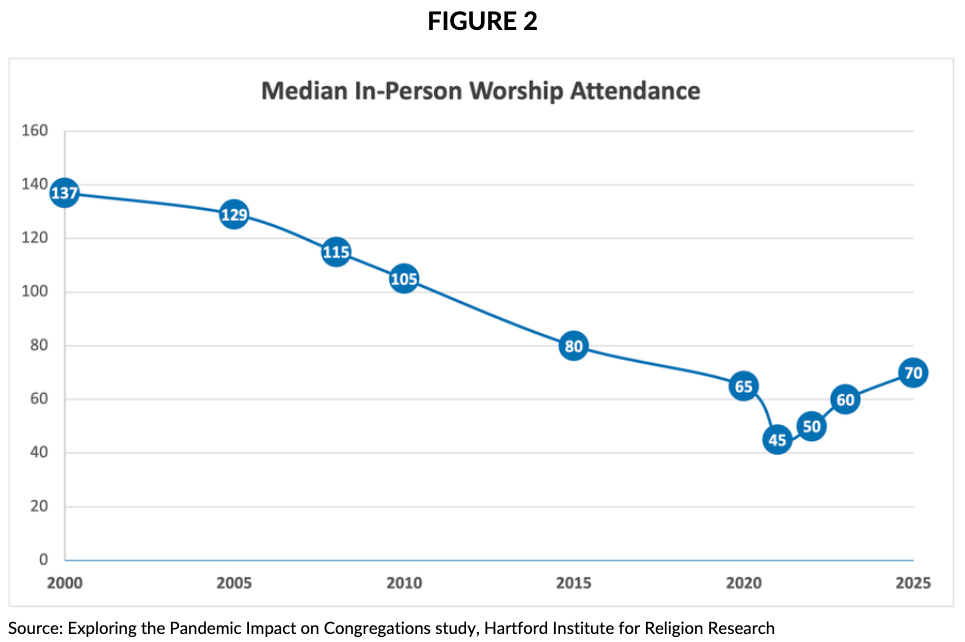
  • “Median in-person worship attendance has risen to 70 — surpassing pre-pandemic levels and marking the first positive gain in 25 years of tracking
  • “Median congregational income reached $205,000 in 2025, well above inflation-adjusted expectations
  • “Volunteer participation has rebounded to pre-pandemic levels, with 40% of congregants now volunteering regularly
  • “58% of congregational leaders say their congregation is stronger now than before the pandemic
  • “Clergy well-being has improved across physical, mental, spiritual, relational, and financial dimensions”

The new report makes me cautiously optimistic about the state of organized religion. The report also confirms anecdotal evidence that at least some congregations are experiencing a bit of growth. Growth, that is, compared to the past few years; 2025 median worship attendance (traditionally one of the best measures of growth) was slightly higher than what it was before the pandemic, and this graph from the report shows:

Graph showing worship attendance over the past 25 years.

The report includes data from many different denominations. Figures for Unitarian Universalism may possibly vary somewhat from the nationwide norm — e.g., from what I remember of the data collected by the Unitarian Universalist Association (UUA), we supposedly hit our peak attendance in about 2005 and thus started declining a bit later than the national average.

On the other hand, attendance data reported by the UUA depends on figures reported by local Unitarian Universalist (UU) congregations, and from what I’ve seen, many local UU congregations are not good at collecting data on average attendance. I’d place far more trust in the data collected by Hartford Institute for Religion Research — just remember as you read their report that Unitarian Universalists fit neatly into the sociological category of “Mainline” congregations.

I’m only cautiously optimistic, because the trends outlined in Robert Putnam’s book Bowling Alone continue — most Americans no longer want to participate in voluntary associations. And in spite of all the chatter about how isolated people are feeling these days, it remains hard to convince most Americans that showing up at a values-based community once a week might help reduce their feelings of isolation. If we could just convince people of that, then we might see a more robust increase in weekly attendance.

Cohasset Patriots

It’s Patriots Day tomorrow, and I’m giving a sermon tomorrow telling the stories of three Cohasset Revolutionary War heroes and heroines, all of whom would have attended services in our 1747 meetinghouse. These three were Persis Tower Lincoln Hall, Briton Nichols, and Noah Nichols.

Due to the time constraints of a sermon, I have to give shortened versions of their life stories tomorrow. I had hoped to post fuller versions of their life stories here, but the research took much longer than I had planned and I’m out of time. Instead, I’ll put a timeline of Noah Nichols’s life after the jump — just to get the information on the web where it’s publicly accessible.

So… just in time to commemorate Patriot’s Day, here’s the life of Captain Noah Nichols….

Continue reading “Cohasset Patriots”